
What should a company consider when buying an electric vehicle?
26 October 2023

Electric mobility is no longer a vision of the future, but a reality of today. In Latvia too, the number of electric vehicles is growing strongly, not only in the private sector but also in the business sector, with a 158% increase in 2022. In addition, the geopolitical situation and the realities of the energy sector are further contributing to a rapid transition to clean energy, thus increasing Europe’s energy independence.
With the increasing availability of electric vehicles, more and more companies have already added one or even more electric vehicles to their fleets and are considering purchasing them in the near future. Charging points are also being targeted outside offices, open to both customers and employees, opening up new business opportunities and contributing to sustainability.
However, it is not enough for a company to purchase a suitable electric vehicle, it is also important to take the research and planning steps for fleet electrification, for example by finding out what the commuting habits of employees are, how the charging infrastructure will be provided, which solutions are best, what reports are needed and how to train employees to use the electric vehicle more actively after purchase.
The answers to these and other topical questions are explained by Elektrum’s electromobility expert Edgars Korsaks-Mills, who has been driving electric vehicles on a daily basis for more than six years and regularly educates companies on the use of electric vehicles, and Andris Valdemārs, Transport Services Director at Latvenergo AS, who is already in charge of a fleet of more than 90 electric vehicles that cover more than 1.5 million kilometres per year.
What should be considered when planning to buy an electric vehicle?
There are a number of steps that need to be taken to make the switch to an electric vehicle. In addition, the transition needs to be planned for the long term, as in some cases the delivery time for new electric vehicles can be up to one year. The first step is to assess the situation, to understand what the outlook is for the development of electric vehicles, the use and utilisation of the company’s fleet and the availability of charging infrastructure.
The next step is to make calculations and determine the projected range, study the market prices of the vehicles and compare the full life cycle costs of different vehicle models. Forecasts by market analysts such as theicct.org demonstrate that purchase price parity for light passenger electric vehicles could occur in 2024, while in the SUV class from 2025. The longer the term, the more the mileage of an electric vehicle is predicted to be equivalent to a vehicle with an internal combustion engine. This will further encourage operators to opt for a phased fleet replacement plan.
Each vehicle needs to be assessed in terms of its operating mode – how much it is driven and where, its maximum daily mileage, where it can be parked at night, the charging possibilities at specific locations and routes, whether the charging time can be combined with, for example, lunch, etc. Elektrum’s electric vehicle test catalogue elektrum.lv/elektroautotesti can also help in the choice of a vehicle, where you can analyse the actual kWh/km consumption, charging speed and other data for most of the electric vehicles available in Latvia. All data are from real tests in Latvia and the results are different from those of the manufacturers.
The next step is to start planning well in advance how the charging infrastructure will be provided, including an assessment of the current electricity tariff of the company at each site (if there are several) and whether this will also be viable at the time of charging. Then, putting these two steps together, you can proceed to purchase an electric vehicle.
When purchasing an electric vehicle, it is recommended to determine the most favourable evaluation based on several evaluation criteria, for example, comparing the purchase price, estimated life cycle costs, technical parameters relevant to the performance of the work, the distance covered with one charge, the capacity of the AC charging device built into the vehicle and the maximum supported DC charging capacity, comfort equipment included in the price, for example, heat pump, driving assistance and safety options, the results of car safety tests by independent organisations, the deployment of warranty services, factory warranty conditions and, of course, the delivery period.
Once the vehicles have been delivered, it is necessary to observe what the vehicle users do – this is likely to require a change in user habits and additional time for personnel training. The use of electric and internal combustion engine vehicles is different.
It should also be borne in mind that the kilowatt hours consumed by electric vehicles should be recorded and the necessary accounting reports should be prepared. Currently, the regulatory documents do not provide for a simplified payment procedure with the employee if the company’s vehicle is charged at home. For each such situation, it is recommended to consult the State Revenue Service.
Specificities of electric vehicles and applicable taxes
Vehicles for which electricity is indicated as a fuel type in the vehicle register, i.e., electric vehicles, are subject to the tax and accounting requirements of the laws and regulations in a similar way as any other vehicle, but there are differences.
- Operating Tax (OT) – does not apply to electric vehicles.
- Road User Charge (RUC) – no difference from fossil transport. If the electric vehicle is a heavy goods vehicle (category N1) and meets the conditions of Section 2 of the Law on the Road User Charge (including if its laden weight exceeds 3000 kilograms), the RUC is payable and there are no exemptions for electric vehicles.
- Value Added Tax (VAT) – no difference from fossil transport. In one case, where a company also uses an electric vehicle it owns for personal journeys (a vehicle or a lorry of a design and equipment meeting the criteria of Section 100 of the Value Added Tax Law) and pays company car tax (CCT) on it, a limit of 50% on the amount of input VAT attributable is applied. In the second case, if the purchase value of the electric vehicle exceeds the threshold for a representation car laid down in the Enterprise Income Tax Law,a limit of 100% of the input VAT amount is applied.
- Company Car Tax (CCT) – there are savings. If the design and equipment of an electric vehicle or goods vehicle meets the criteria of Chapter III, Section 10 of the Law on Vehicle Operation Tax and Company Car Tax and the company also uses the electric vehicle it owns for personal journeys, it has to pay CCT of EUR 15 per month, which is much less than for fossil vehicles over an annual period. The exemption from CCT applies in the same way as for VAT, by installing a GPS device and declaring it in the CSDD register.
- Enterprise Income Tax (EIT) – no difference from fossil transport, but there are a number of inaccuracies with the electricity consumption norms. Also, the journeys made and the electricity purchased and used for the journeys must be recorded, and the data must be included in the period operating reports (waybills). Given the fact that it is compulsory for each company to have a document approved by the person in charge with the electricity consumption norms for each car (M1 category) and heavy goods vehicle (N1 category), expenditure on the purchase of fuel (including electricity) is attributable to the economic activity of the company provided that it does not exceed the limit set by Section 8, Clause 5, Sub-clause 5 of the Enterprise Income Tax Law: the consumption calculated in the waybill must not exceed the "fuel consumption norm of a city cycle indicated by a manufacturing plant by more than 20 percent".
For the company’s accountant and fleet manager, the confusion arises from the fact that for electric vehicles produced in previous years, the factory indicated only one consumption on the EC Certificate of Conformity (also known as COC certificate or car passport in the automotive industry) – Electric energy consumption – which could be assumed to be the combined mode (this figure was also recorded in the CSDD register). The consumption limitation imposed by the COC (maximum +20%) for such electric vehicles should be applied to the only “demonstrable” consumption rate, which is not in line with the principle of equal treatment compared to fossil vehicles, for which the COC shows both urban, non-urban and combined mode consumption, with fossil vehicles (excluding hybrids) having the lowest consumption in non-urban mode, the highest in urban mode, and combined mode consumption in the middle respectively. In this case, the EIT law creates a disadvantage for entrepreneurs who are thinking of reducing emissions and who initially buy a more expensive electric vehicle compared to a fossil vehicle of the same class. The EIT limit does not currently take into account the specificities of this consumption data for electric vehicles.
For the latest fossil and electric models, the COC certificate shows five consumption levels at different driving speeds: Low – up to 56.5 km/h; Medium – up to 76.6 km/h; High – up to 97.4 km/h; Extra-high – up to 131.3 km/h; Combined, but none of these corresponds directly to the city cycle, as defined in the current version of the EIT law, against which the maximum fuel and electricity consumption attributable to the economic activity should be calculated.
Furthermore, if we continue to analyse the COC data for newer models, we can see that the electricity consumption of electric vehicles in Low mode (which is essentially the city cycle) is the lowest among the five COCs (e.g., the 2023 Opel Mokka-e in Low mode at a maximum speed of up to 56.5 km/h has a factory stated consumption of 109 Wh per km); in contrast, the highest power consumption is found in both highway High and Extra-high modes (e.g., the 2023 Opel Mokka-e in High mode at speeds up to 97.4 km/h consumes 142 Wh per km, while in Extra-high mode at speeds up to 131.3 km/h it consumes 218 Wh per km). Again, the EIT results in the unequal treatment of electric vehicle owners and creates uncertainty as to whether the EIT condition would be breached by attributing the higher of the Extra-high consumption to the expense, and which factory mode consumption should be considered as the notional city cycle – Low with the lowest city consumption or Extra-high with the highest highway consumption?
In addition, the COC certificate data for all electric vehicles (both newer and older) also shows the range per charge in Electric range city and Electric range conditional combined driving modes, which unlike fossil vehicles have the highest range per charge (and therefore the lowest electricity consumption) in Electric range city driving mode, which creates further contradictions when reading the EIT law regarding the +20% limit on the city cycle fuel consumption rate.
As partial help for entrepreneurs, the answer published on the website of the State Revenue Service under FAQ – Catalogue > Enterprise Income Tax > EIT for vehicles with a reference to Elektrum’s electric vehicle test catalogue may be useful: "In order to ensure that the requirements of Section 8, Clause 5 of the Enterprise Income Tax Law are also met for the application of enterprise income tax to the electricity consumption of electric vehicles, the electric vehicles must take into account the highest of the manufacturer’s electricity consumption figures or a publicly available average consumption figure or, for example, one of the figures from a publicly conducted test."
Entrepreneurs are advised to consult the State Revenue Service if they encounter any of the above uncertainties regarding the calculation of the tax on electric vehicles.
What do I need to know about the charging rate of an electric vehicle?
Electric vehicle charging stations are divided into different groups and mainly according to the type of current used for charging – AC or DC. The charging time depends on the type of charging station chosen and its available capacity, as well as the vehicle’s battery capacity and other factors such as the capacity of the built-in charger of the electric vehicle, the type of battery cooling system, the driving mode chosen and the outside air temperature.
Electric vehicles are charged by direct current, so every electric vehicle has a built-in charger that provides power conversion when charging from alternating current. Therefore, the maximum charging rate of an electric vehicle will not only be affected by the power of the electricity connection but also by the power of the charger. The base EV is most often equipped with a 6–7 kW charger (this can be increased as an option), so connecting an 11 kW or 22 kW EV to AC charging will result in a charging speed equivalent to a 6–7 kW unit. This should be taken into account when selecting the appropriate AC charger for the electric vehicle purchased.
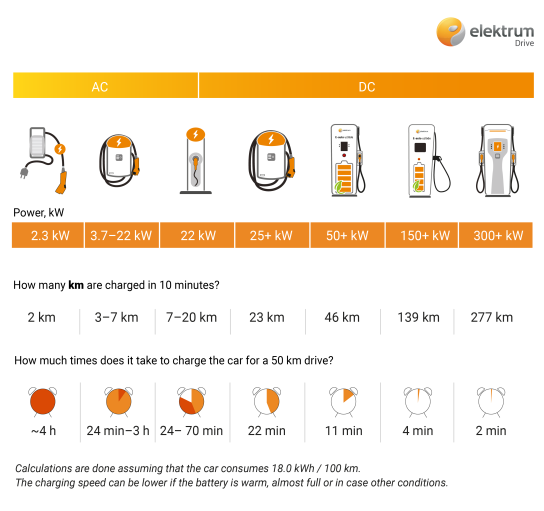
The situation is different at fast charging stations where the electric vehicle is charged with direct current. This means that the built-in charger is no longer used, but instead, the power converter at the charging station fulfils the function. Therefore, the charging speed is several times higher – it is not limited by the capacity of the built-in charger. However, when choosing to install DC or fast charging stations, it is important to bear in mind that this is the most expensive solution available on the market, so it is advisable to carefully consider both people’s commuting habits and the return on investment. Before making a decision, it is advisable to investigate and test publicly available fast chargers already available in the vicinity.
What if a company wants to install a charging point on its premises?
The most important thing is to make sure that you get the help of knowledgeable experts in the field of design, charging and electric vehicles, as there are a number of essential conditions for successful installation. First, the charging equipment must be suitable for the electric vehicles for which it is designed. Secondly, the location of parking spaces, the availability of communications, as well as the existing electricity supply infrastructure and the availability of spare capacity must be taken into account. Finally, the maintenance of the charging point, the provision of a management system for reporting, and the possibility of future expansion of the charging point should be planned.
Electric vehicles can be charged using a plug socket, but this is the slowest and most impractical way of charging, as it can cover a distance of around 8 to 20 kilometres in one hour. The best and most sustainable solution is a Wallbox or free-standing charging unit that allows the vehicle to be charged at the maximum capacity provided by the manufacturer, with authorisation of the user performing the charging and a record of the amount of energy charged per user. These devices have additional built-in electrical protection devices, as well as the possibility to connect several devices in one communication network. It should be noted that the installation of such equipment shall be carried out by a qualified electrician.
When creating a charging point, the possibility of using the existing connection should be evaluated. If it is not possible to use the existing connection in full, a good solution is power balancing by correcting the previously calculated projected charging mileage and consumption profile accordingly. If the required parameters are still not achieved, additional capacity must be requested from Sadales tīkls AS.
There is no clear answer to the question: what is the best charging equipment? Each case is individual. It is necessary to understand the purpose of the charging, how many and which electric vehicles are already in use and what the future purchase plans are, what the technical parameters and available capacities for charging electric vehicles are, what the characteristics of the installation site are, what the preferred settlement procedure with customers is. These questions should be answered first, and then the capacity, design and installation costs of the charging equipment should be agreed upon with the experts.
Elektrum Drive offers a full range of services, right up to the installation of a charging station on site, and we invite you to apply for a free consultation by filling in the application form at elektrum.lv. In addition, Elektrum Drive supports different cooperation models and solutions according to the partner’s desired investment in the project, providing both partial and full financial support for the construction and equipping of the charging station.